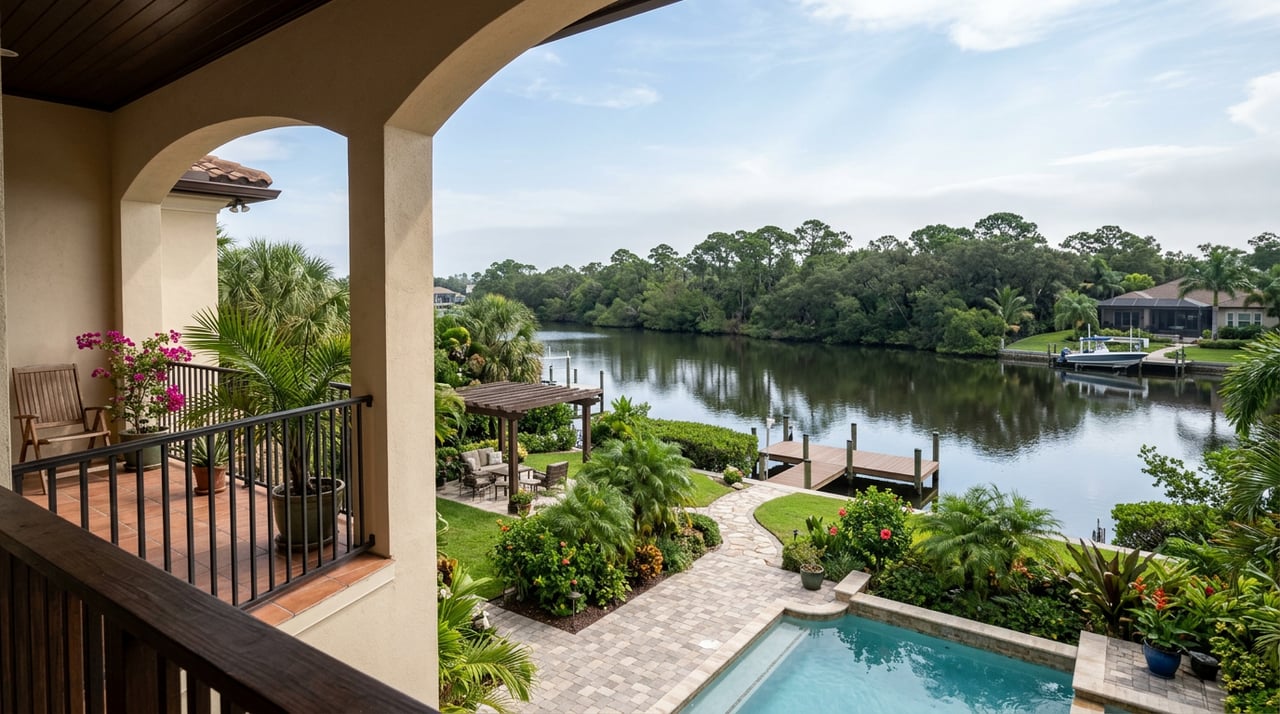
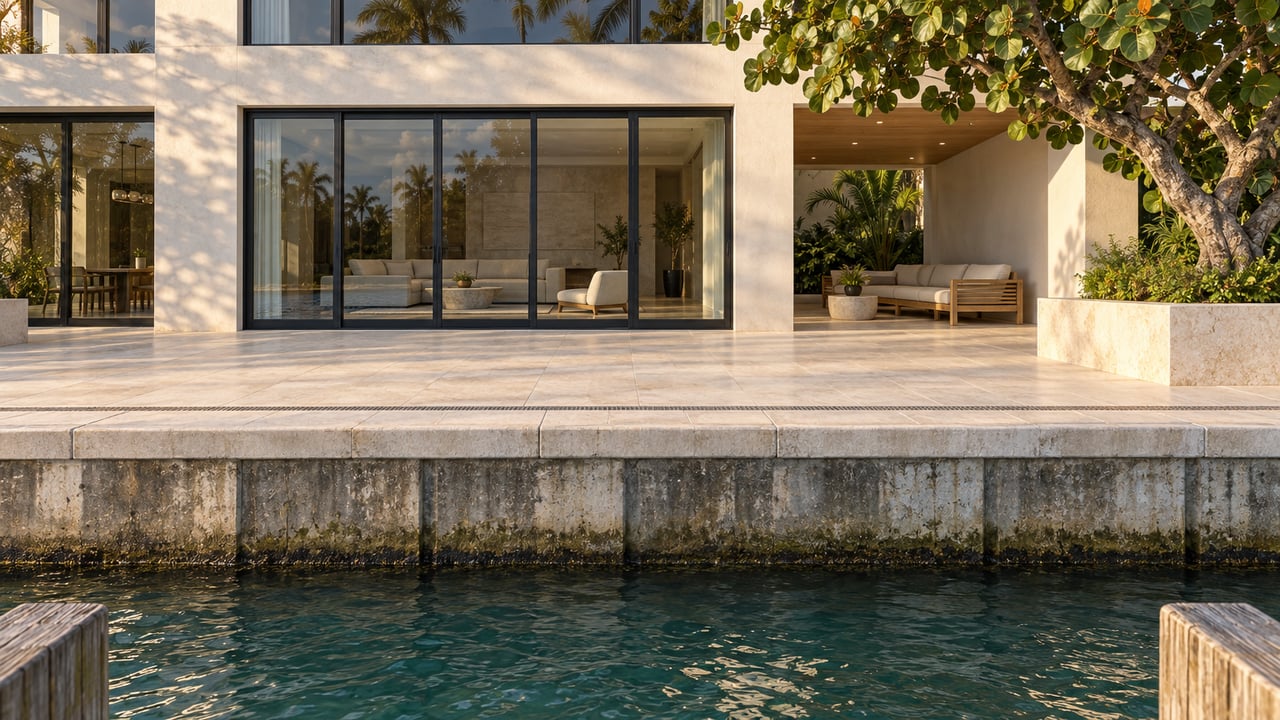
Ask a Fort Lauderdale seller with an aging seawall when the new elevation rule takes effect, and most will say 2035. That answer only holds if the wall stays exactly as damaged as it is today. The moment a repair crosses a certain size, the taller, more expensive standard applies immediately, years ahead of the date everyone quotes. For a canal-front seller weighing a $15,000 patch against a $60,000 rebuild, that distinction is worth more than the calendar.
The rule behind the deadline
Broward County adopted its regional resiliency standard, Policy 2.21.7, on January 7, 2020, directing tidally influenced cities to set consistent minimum heights for seawalls, banks, and berms. The framework, codified as Chapter 39, Article XXV of the county code, sets a five-foot NAVD88 minimum for any new or substantially repaired tidal flood barrier. Applications submitted before January 1, 2035 can still be permitted at four feet, as long as the design accommodates the jump to five feet by January 1, 2050. The county's own language is worth reading directly on Broward's resiliency standard page, because it also defines a wall as presumed to be in disrepair if tidal water flows unimpeded through or over it onto neighboring property or the public right of way.
Fort Lauderdale had already moved on this before the county's regional standard arrived, raising its own minimum seawall height years earlier. What matters for a 2026 transaction is the trigger buried in the word substantial. Marine engineers and coastal contractors describe the threshold as roughly 50 percent of the existing wall. A seawall needing repair below that line can often be patched to the lower, cheaper standard. One needing repair at or above it gets treated as new construction and must meet the incoming height requirement now, not in nine years.
That single percentage is why two seawalls in similar visual condition can carry very different repair estimates, and why the number on an inspection report matters more than the adjective the inspector uses.
| Scope of work | Typical cost | What triggers it |
|---|---|---|
| Standard repair or panel patch | $150 to $500 per linear foot | Damage assessed below the substantial-repair threshold |
| Full elevation increase to meet code | $500 to $1,000 per linear foot | Repair assessed at or above the substantial-repair threshold, or new construction |
| Full seawall replacement | $20,000 to $100,000 or more per property | Structural failure, extensive erosion, or a wall past its 30 to 50 year service life |
What this means at the negotiating table
A seller with a marginal seawall has a real incentive to act before additional deterioration pushes the damage assessment past the substantial-repair line. A targeted repair filed today, while the wall still qualifies below that threshold, can lock in the lower four-foot standard with the 2050 upgrade obligation attached to the property rather than the seller's closing statement. Wait two storm seasons and the same wall may only qualify for a full, five-foot rebuild.
For buyers, the useful question is not "does the seawall look okay" but "what percentage of damage does the marine contractor's report show, and has any permit already been filed." Because the standard is tied to when the application is submitted, not when construction finishes, a permit filed before 2035 can carry the lower compliance path forward even if the actual work happens later. That detail belongs in the inspection contingency, not as a verbal assurance from the listing agent. Broward's disclosure framework already expects sellers to flag tidal flooding exposure and seawall condition, so asking for that documentation in writing is a reasonable, ordinary part of due diligence rather than an unusual demand.
The permit clock nobody budgets for
Marine permitting in Broward routinely runs three to four months once engineering review, county environmental licensing, and city sign-off are stacked in sequence. Broward County issues two tiers of environmental approval depending on scope. A General License covers lower-impact work, such as a seawall built within 12 inches of the mean high water line or a dock replacement under 500 square feet. Anything larger moves into the more detailed Environmental Resource License review. Fort Lauderdale layers its own waterway ordinance on top, and unusual dock configurations can be routed to the city's Marine Advisory Board before approval.
A typical residential closing runs 30 to 45 days. A marine permit does not. That mismatch is why "the seller will just fix it before closing" is rarely a workable contingency for anything involving a dock, lift, or seawall. Price credits, extended closing dates, or escrow holdbacks tend to be the realistic paths, and knowing that going into the offer avoids a late-stage renegotiation.
Unpermitted structures are common enough in older canal neighborhoods to plan for rather than hope around. Pockets of Rio Vista, Tarpon River, and Croissant Park carry decades of homeowner-built docks, screened patios, and additions that accumulated without permits long before current owners bought in. Fort Lauderdale's historic districts add another layer: work in Sailboat Bend or the area around the Stranahan House requires Historic Preservation Board review for exterior changes, and unpermitted work in those zones tends to surface as code-enforcement letters years after the fact rather than at the time it was done. An unpermitted dock or lift found during due diligence is not automatically a deal-breaker, but it is routinely a cost, since it may need to be removed or retroactively permitted at the buyer's expense if the issue isn't resolved before closing.
Access is not just the dock, it's the route
A dock that is structurally sound and fully permitted still might not deliver the boating access a listing implies. Two measurements decide that: what sits above the waterline and what sits below it.
Above the waterline, most fixed bridges in Fort Lauderdale clear 14 to 17 feet at mean high water, though the citywide range runs anywhere from 8 to 25 feet depending on the crossing. The FEC and Brightline rail bridge over the New River is the outlier worth knowing by name. It clears only about 4 to 5 feet when closed, and because it operates on freight and passenger rail schedules rather than boater demand, it creates real, unpredictable delays for anyone transiting that stretch with a tall vessel.
Below the waterline, definitions of deep water are not standardized across listings. Some describe it as six feet or more at mean low tide, others use eight feet at mean low water. That gap matters for anyone with a deeper draft, and it means a buyer should confirm the actual sounding rather than trust the word deep-water on a listing sheet.
The physical dock itself has limits too. Broward's canal ordinances generally cap a dock and moored vessel at roughly 30 percent of the canal's width measured from the property line, so a 100-foot canal caps the extension near 30 feet. Several cities flatten that to a fixed 5 feet on narrower interior canals regardless of the percentage, which surprises owners planning a larger platform than the canal can actually support. Side setbacks of 5 to 10 feet from each property line stack on top, and details shift by neighborhood and sometimes by street, with Fort Lauderdale applying its own setback and length standards through its waterway ordinance. The full text of that ordinance is public record through the city's dock and boat slip code.
Neighborhoods carry different profiles as a result. Las Olas Isles, Rio Vista, Coral Ridge, Harbor Beach, and Sunrise Key generally route to the New River and the Intracoastal, while Bay Colony and Seven Isles are known for deep-water canal access with fewer bridge constraints between the dock and open water. That difference shows up in price. A functional private dock typically adds 5 to 15 percent to a waterfront home's value compared to a similar property with a seawall alone. A deep-water dock capable of handling a 50-foot or larger vessel can add 15 to 25 percent or more, and that premium concentrates in the neighborhoods where true no-fixed-bridge routes to the ocean are scarce, particularly Harbor Beach, Seven Isles, and Las Olas Isles.
Before you sign: a short due diligence list
- Request the marine contractor's seawall report with a stated damage percentage, not just a pass or fail summary
- Ask whether any seawall or dock permit application has already been filed with the city or Broward County, and on what date
- Pull the dock's permit history directly rather than relying on a listing description
- Confirm bridge clearance and water depth for your specific vessel using current NOAA charts rather than a general neighborhood reputation
- Budget for a three to four month permit timeline on any marine work, and structure the contract around a credit or escrow rather than a pre-closing repair deadline
Does the 2035 deadline apply to docks and lifts too, or just seawalls?
The elevation standard is specific to seawalls, banks, and berms functioning as tidal flood barriers. Docks and lifts fall under separate permitting requirements, though they are frequently inspected and permitted alongside seawall work since damage to one often signals damage to the other.
If my seawall passed a visual inspection, do I still need the percentage figure?
Yes. A visual pass does not tell you where the wall sits relative to the substantial-repair threshold. Two walls that both "look fine" can be in very different positions if one has more hidden erosion or panel movement below the waterline, which is why a marine contractor's below-water assessment matters more than a surface walkthrough.
Who is financially responsible for bringing a seawall up to the new standard?
Ownership responsibility for seawall maintenance and compliance rests with the property owner, which is why the timing of a repair permit becomes part of a real estate negotiation rather than a purely technical matter left for after closing.
Waterfront transactions in Fort Lauderdale carry more moving parts than a standard sale, and most of them surface only after an offer is already in. Florida Exclusive Living works from a team with backgrounds in construction, property management, and risk management specifically because these are the details that decide whether a closing stays on schedule. If you're evaluating a canal-front or Intracoastal property and want the seawall history, permit status, and access route checked before you write an offer, reach out and we'll walk through it with you.